
How to Start a Drug Testing Business
How to Start a Successful Drug & Alcohol Testing Business Whether you're looking to launch a new business, expand your existing services, or enter the rapidly growing drug and alcohol testing industry, this comprehensive course provides the knowledge, tools, and strategies you need to build a successful and profitable testing business from the ground up. Designed for entrepreneurs, healthcare professionals, collectors, safety consultants, mobile service providers, and anyone interested in owning and operating a drug and alcohol testing company, this course takes you step-by-step through every aspect of planning, launching, managing, and growing your business. You'll learn not only what it takes to open your doors, but also how to establish credibility, generate revenue, build long-term client relationships, and create multiple streams of income within the drug testing industry.

Conflict Mitigation Training for Drug Screening Professionals
Our Conflict Mitigation Training equips drug and alcohol screening professionals with tools and strategies for dealing with difficult specimen donors and moving a test forward — even when they encounter resistance.

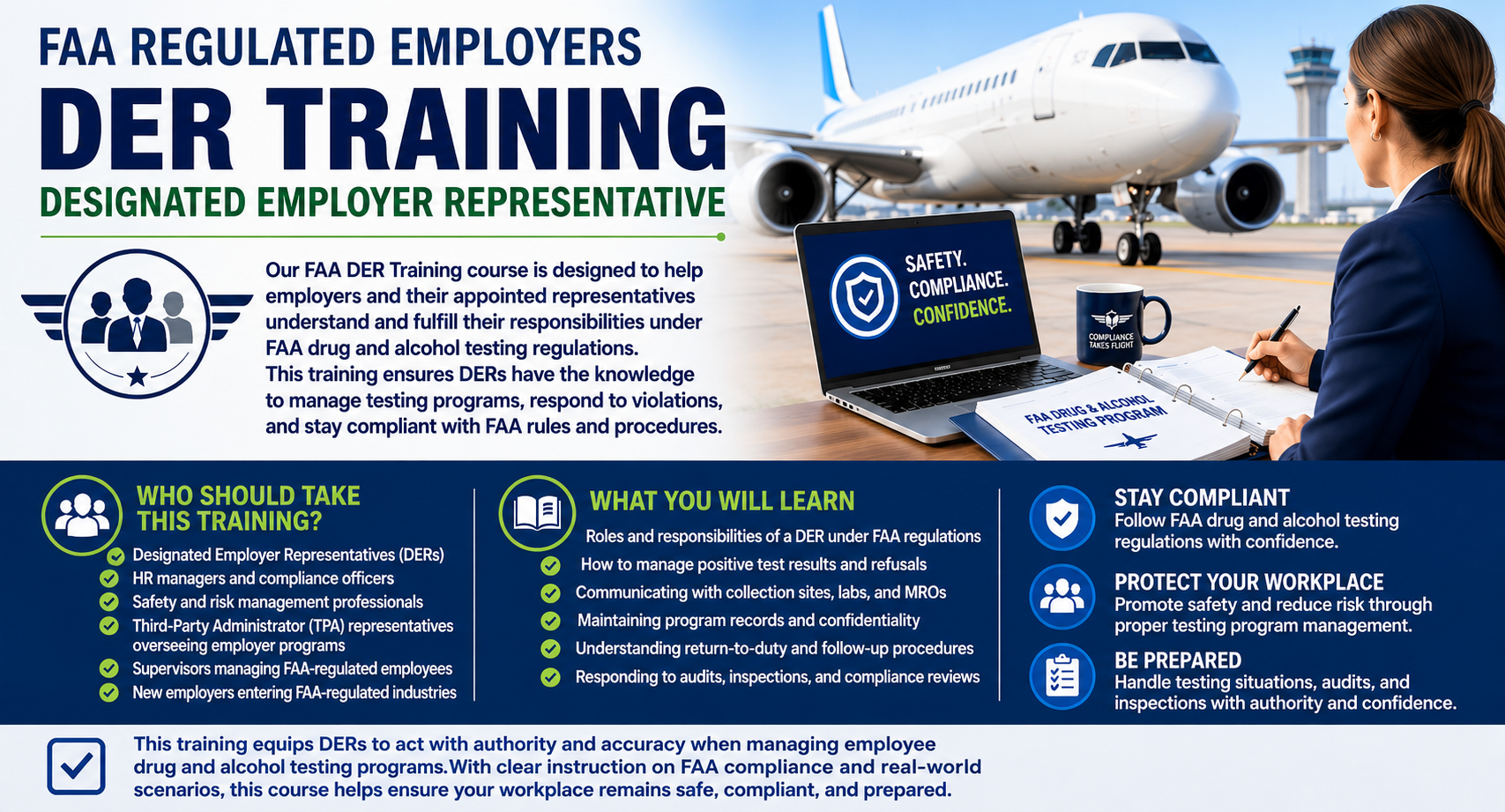
DER Training Modal Addendum: FAA
Upon completion, participants will have the confidence and knowledge necessary to administer an FAA-compliant drug and alcohol testing program, reduce regulatory risk, and contribute to a safer aviation environment. Whether you operate a commercial airline, repair station, charter operation, cargo carrier, or aviation support company, this course provides the tools needed to effectively manage compliance while supporting the highest standards of aviation safety.

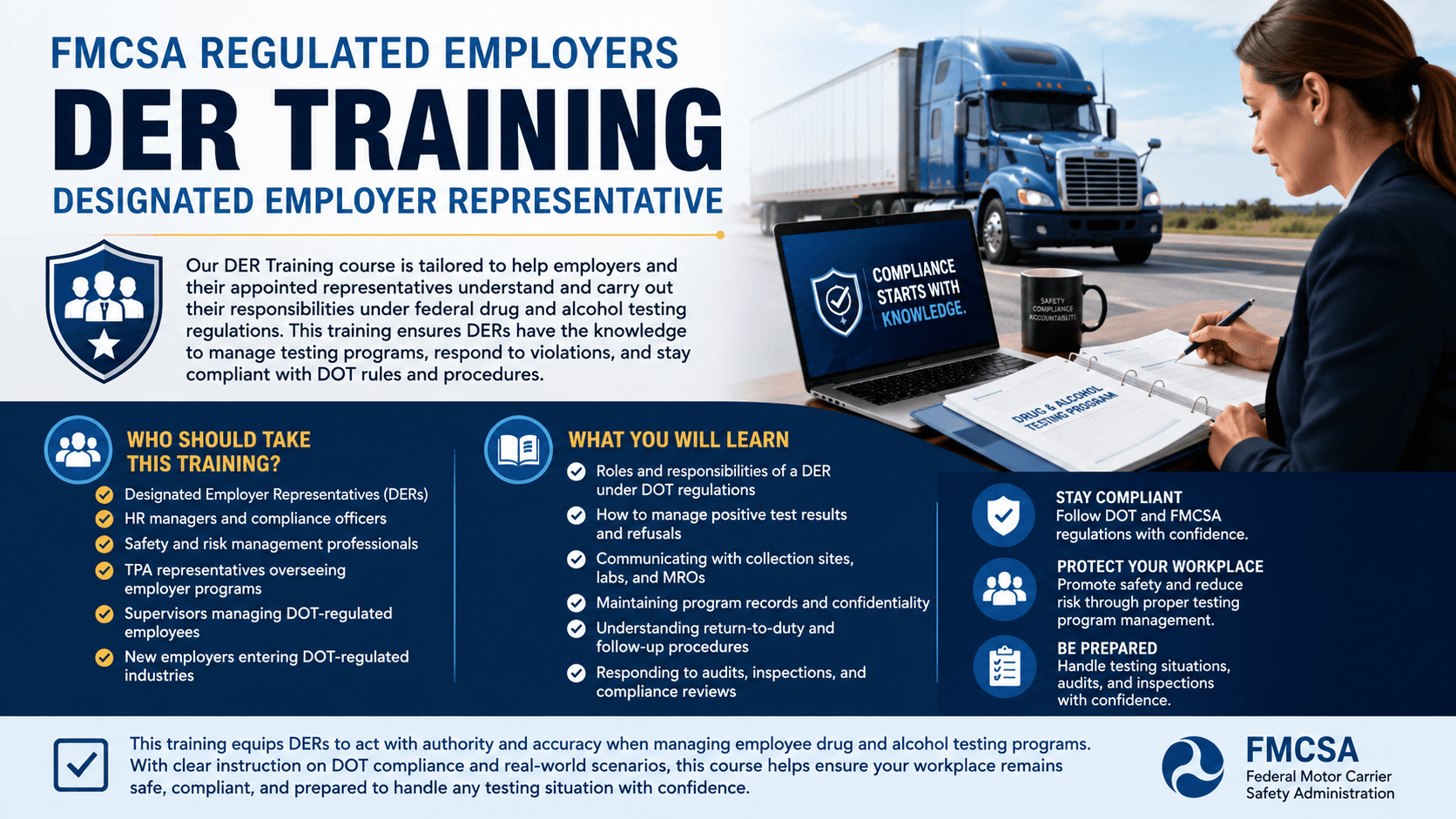
DER Training Modal Addendum: FMCSA
Upon completion of this course, supervisors working in businesses that employ Commercial Drivers License holders and others regulated by the Federal Motor Carrier Safety Administration (FMCSA) will have the skills to take on the role of Designated Employer Representative, with specialized knowledge about the drug and alcohol testing practices and processes required by FMCSA. The individual in this critical position is responsible for ensuring employer compliance with federally mandated drug and alcohol testing regulations and FMCSA-specific requirements. This addendum is an enhancement to the self-guided Designated Employer Representative (DER) training. The course details the protocols and processes required by the Federal Motor Carrier Safety Administration (FMCSA) under 49 CFR Part 382 for businesses that employ Commercial Drivers License holders and others regulated by FMCSA where they differ from or expand on the drug and alcohol testing procedures outlined in 49 CFR Part 40. It is critical for the DER to understand and follow the particular requirements of the transportation mode that regulates their industry. The employer risks non-compliance when following DOT protocols, but not those of their modal agency. DERs working with CDL holders and others regulated by FMCSA must be knowledgeable about the guidelines presented in 49 CFR Part 382 in addition to those covered in 49 CFR Part 40.

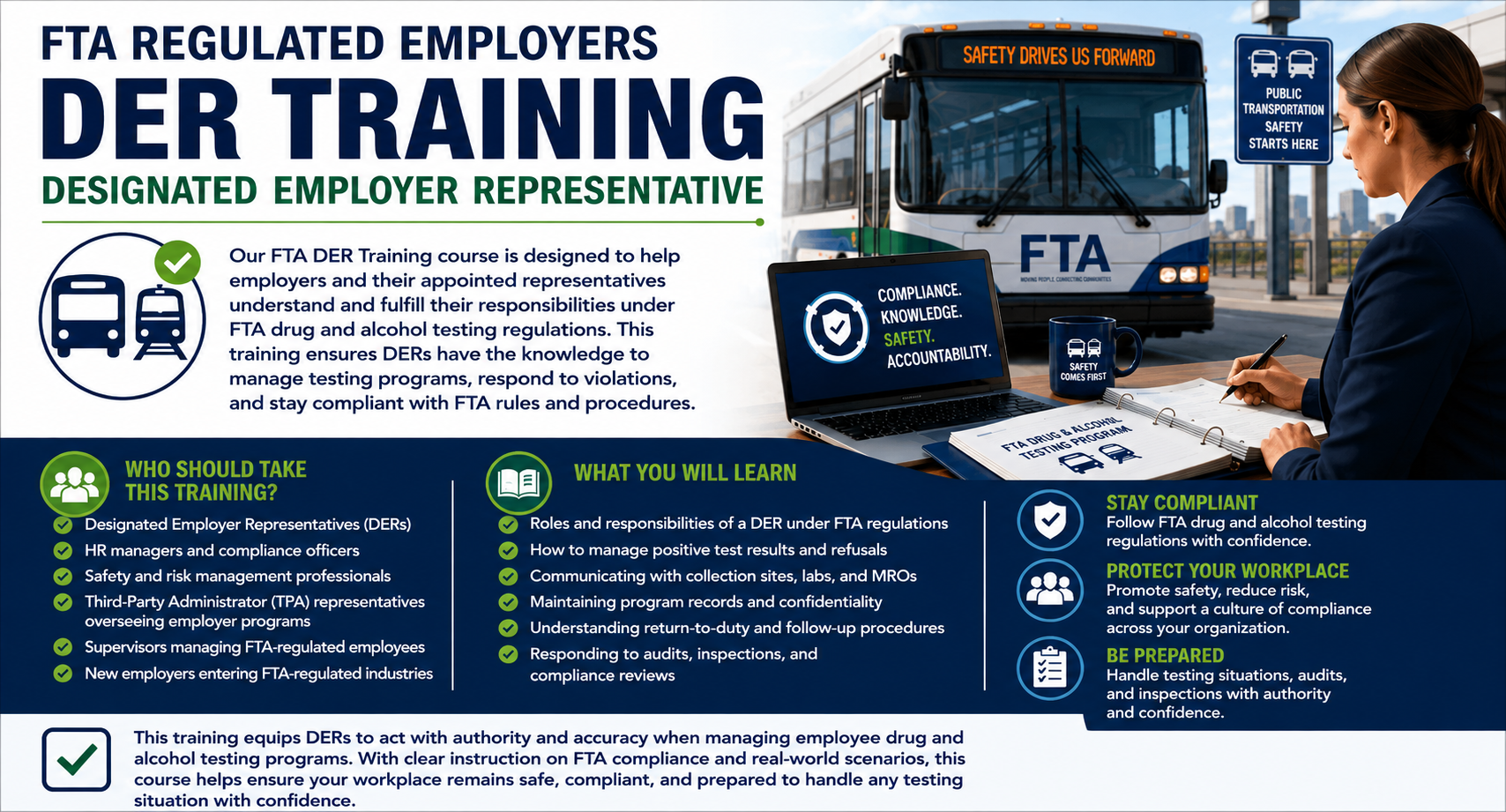
DER Training Modal Addendum: FTA
Upon completion of this course, supervisors working in the transit industry, regulated by the Federal Transit Administration, will have the skills to take on the role of Designated Employer Representative, with specialized knowledge about the drug and alcohol testing practices and processes required by the FTA. The individual in this critical position is responsible for ensuring employer compliance with federally mandated drug and alcohol testing regulations and FTA-specific requirements. This addendum is an enhancement to the self-guided Designated Employer Representative (DER) training. The course details the protocols and processes required by the Federal Transit Administration (FTA) under 49 CFR Part 655 for certain employees in the transit industry where they differ from or expand on the drug and alcohol testing procedures outlined in 49 CFR Part 40. It is critical for the DER to understand and follow the particular requirements of the transportation mode that regulates their industry. The employer risks non-compliance when following DOT protocols, but not those of their modal agency. DERs working with transit employees must be knowledgeable about the guidelines presented in 49 CFR Part 655 in addition to those covered in 49 CFR Part 40.

DER Training Modal Addendum: FRA
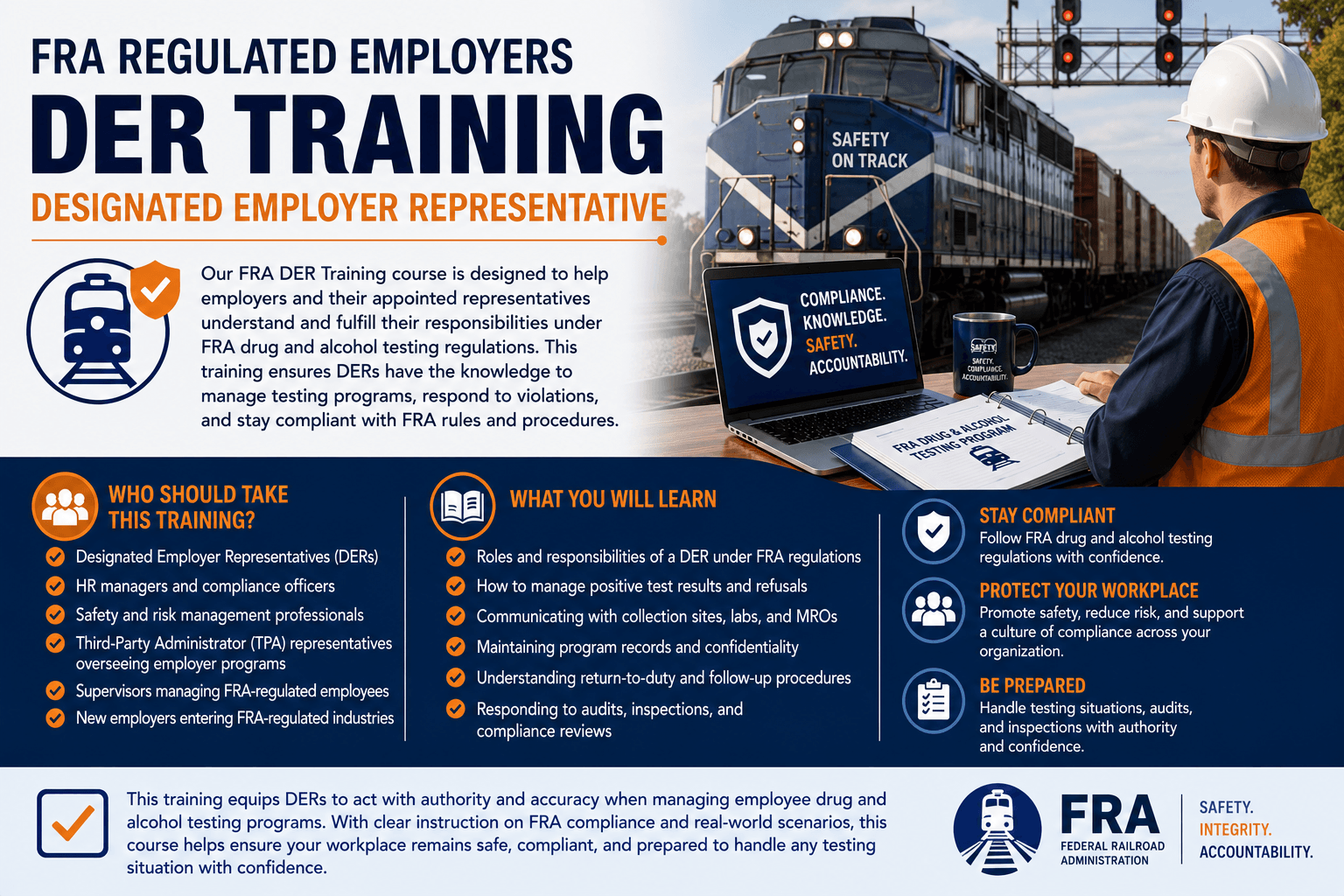
Upon completion of this course, supervisors working in the railroad industry, regulated by the Federal Railroad Administration, will have the skills to take on the role of Designated Employer Representative, with specialized knowledge about the drug and alcohol testing practices and processes required by the FRA. The individual in this critical position is responsible for ensuring employer compliance with federally mandated drug and alcohol testing regulations and FRA-specific requirements. This addendum is an enhancement to the self-guided Designated Employer Representative (DER) training. The course details the protocols and processes required by the Federal Railroad Administration (FRA) under 49 CFR Part 219 for certain employees in the railroad industry where they differ from or expand on the drug and alcohol testing procedures outlined in 49 CFR Part 40. It is critical for the DER to understand and follow the particular requirements of the transportation mode that regulates their industry. The employer risks non-compliance when following DOT protocols, but not those of their modal agency. DERs working with railroad employees must be knowledgeable about the guidelines presented in 49 CFR Part 219 in addition to those covered in 49 CFR Part 40.

DER Training Modal Addendum: PHMSA
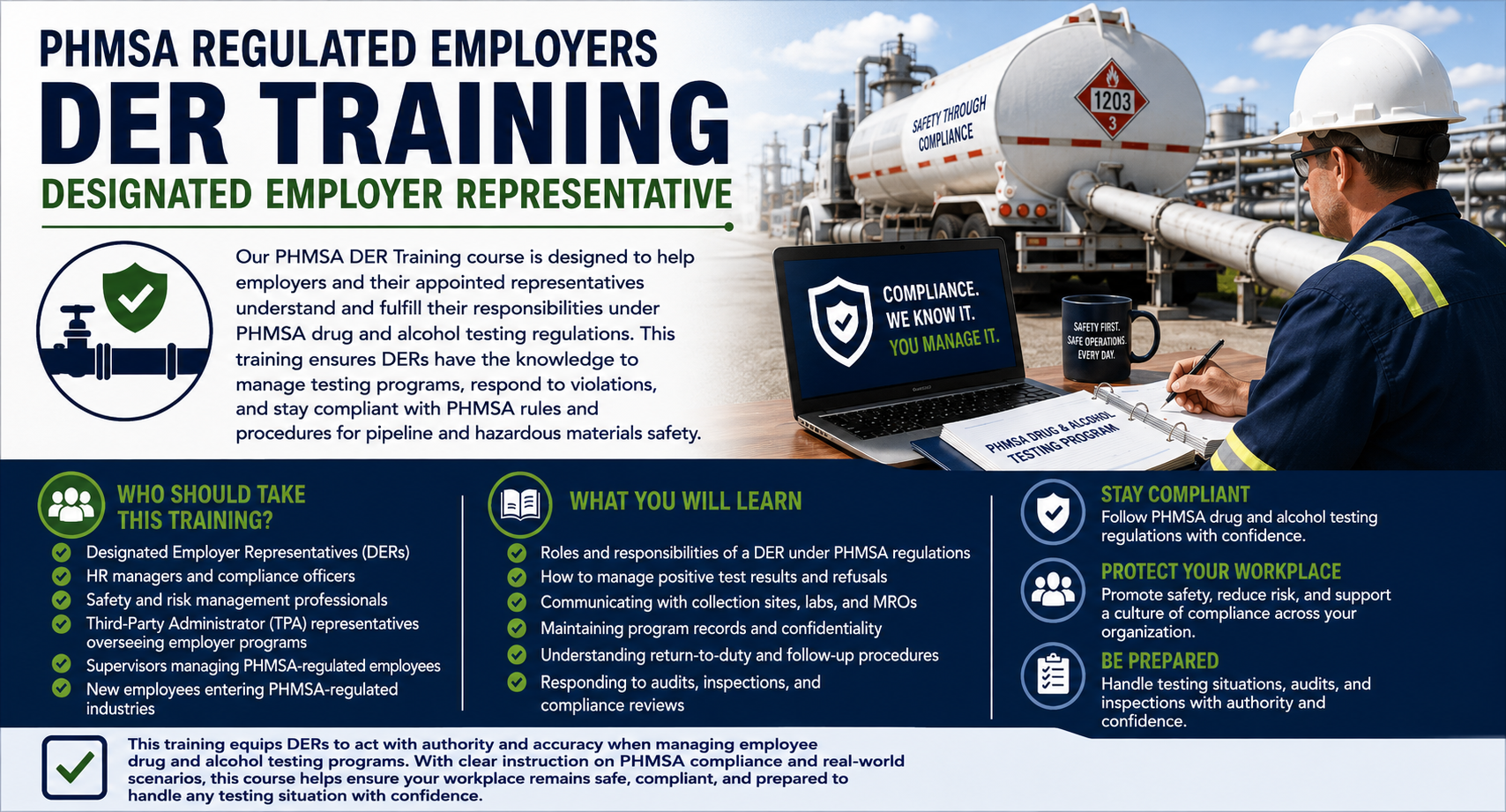
Upon completion of this course, supervisors working for businesses that service pipelines or transport hazardous materials, regulated by the Pipeline and Hazardous Materials Safety Administration, will have the skills to take on the role of Designated Employer Representative, with specialized knowledge about the drug and alcohol testing practices and processes required by PHMSA. The individual in this critical position is responsible for ensuring employer compliance with federally mandated drug and alcohol testing regulations and USCG-specific requirements. This addendum is an enhancement to the self-guided Designated Employer Representative (DER) training. The course details the protocols and processes required by the Pipeline and Hazardous Materials Safety Administration (PHMSA) under 49 CFR Part 199 for certain employees in businesses working on pipelines or in transporting hazardous materials where they differ from or expand on the drug and alcohol testing procedures outlined in 49 CFR Part 40. It is critical for the DER to understand and follow the particular requirements of the transportation mode that regulates their industry. The employer risks non-compliance when following DOT protocols, but not those of their modal agency. DERs working with pipeline and hazardous materials employees must be knowledgeable about the guidelines presented in 49 CFR Part 199, in addition to those covered in 49 CFR Part 40.

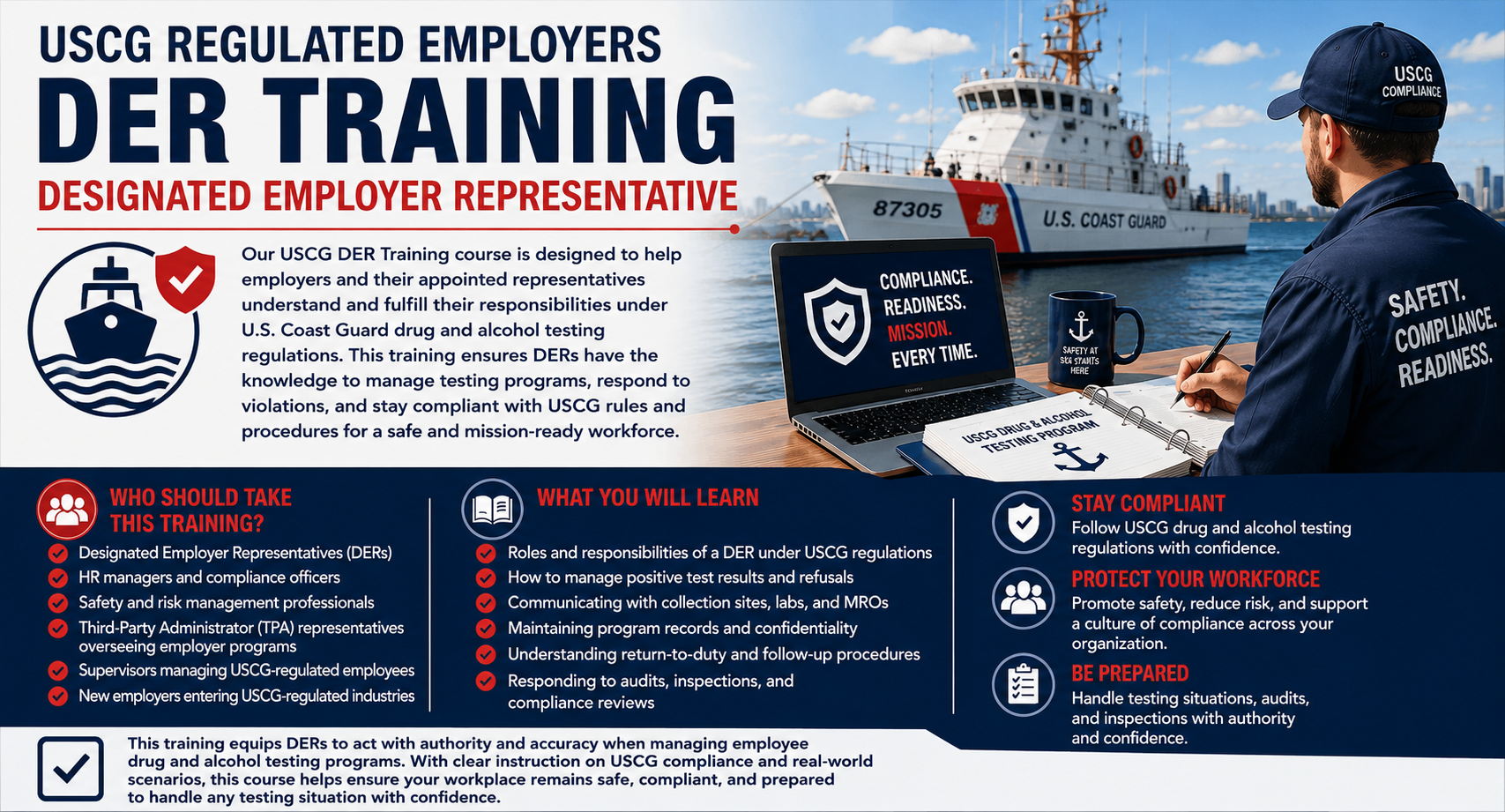
DER Training Modal Addendum: USCG
Upon completion of this course, supervisors working in the shipping and maritime industries, regulated by the United States Coast Guard, will have the skills to take on the role of Designated Employer Representative, with specialized knowledge about the drug and alcohol testing practices and processes required by the USCG. The individual in this critical position is responsible for ensuring employer compliance with federally mandated drug and alcohol testing regulations and USCG-specific requirements. This addendum is an enhancement to the self-guided Designated Employer Representative (DER) training. The course details the protocols and processes required by the United States Coast Guard (USCG) under 46 CFR Parts 4, 5, 16 for certain employees in the maritime and shipping industries where they differ from or expand on the drug and alcohol testing procedures outlined in 49 CFR Part 40. It is critical for the DER to understand and follow the particular requirements of the transportation mode that regulates their industry. The employer risks non-compliance when following DOT protocols, but not those of their modal agency. DERs working with maritime and shipping employees must be knowledgeable about the guidelines presented in 46 CFR Parts 4, 5 and 16, in addition to those covered in 49 CFR Part 40.

DOT Urine Specimen Collection Proficiency Mocks
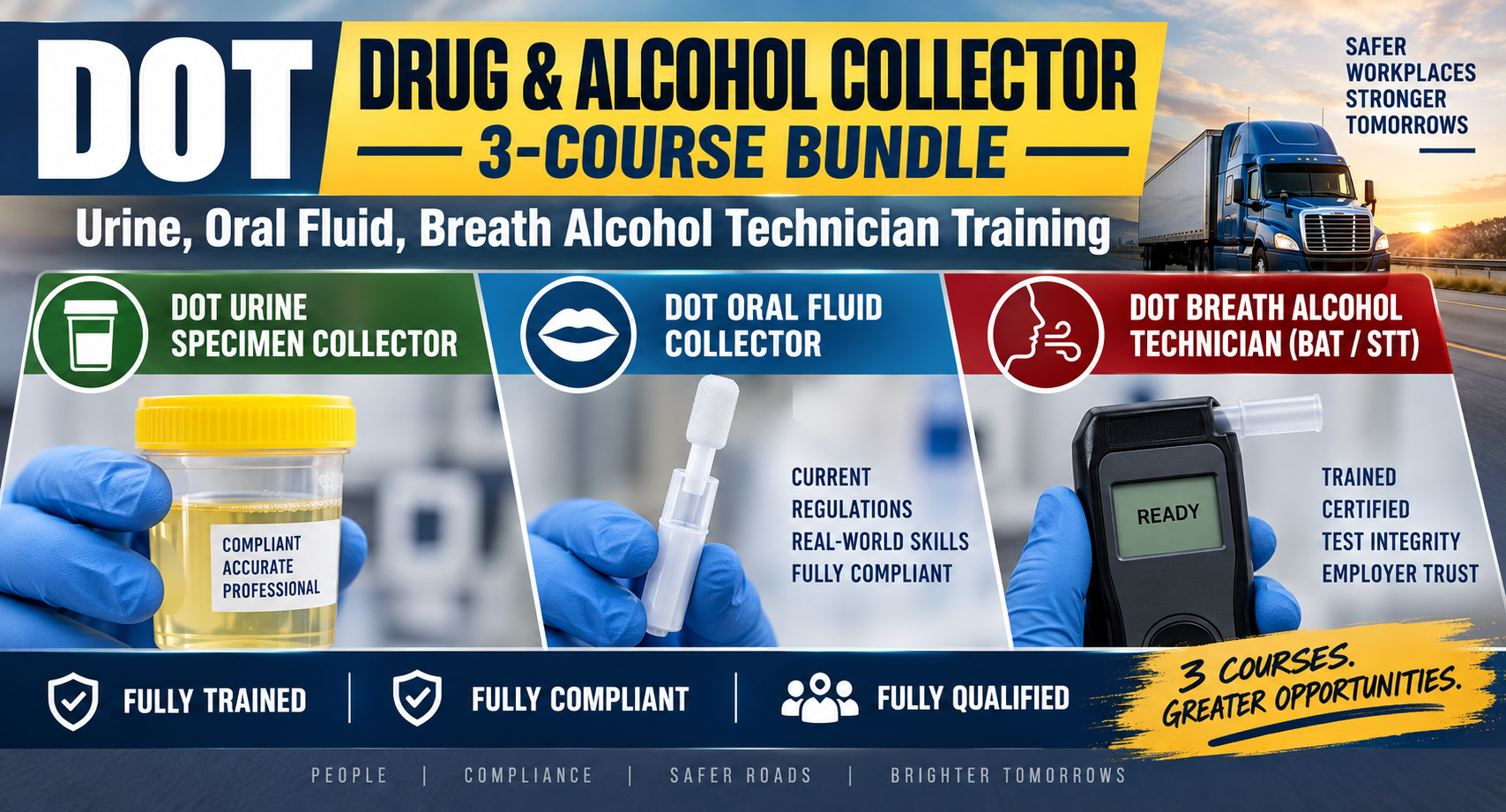
What's Required for DOT Certification To finalize your DOT urine collector qualification, you must complete: Five (5) consecutive, error-free mock collections For each device type used (e.g., split-specimen cups) Observed in real time by a qualified trainer Properly documented on Federal Custody and Control Forms (CCFs)

Conflict Mitigation Training for Drug Screening Professionals (International)
Our Conflict Mitigation Training equips drug and alcohol screening professionals with tools and strategies for dealing with difficult specimen donors and moving a test forward — even when they encounter resistance.

CDER/Train the Trainer (C-DERT)
This is the CDER Exam From Mid Year Training- NOTE this should only be taken after attending an NDASA Live Training Event! Step into a course intentionally crafted for both Certified Designated Employer Representatives (C‑DERs) and Certified DER Trainers, delivering the comprehensive knowledge each role needs to perform—and lead—with excellence. This session dives into This is the CDER Exam From Mid Year Training the tools, knowledge, and strategies DERs need to confidently manage workplace drug and alcohol testing programs in the workplace, uphold compliance with federally mandated requirements, and manage effective policies within their organizations. What you will gain: proven techniques to train future DERs with clarity and confidence, practical insights into federal drug and alcohol testing regulations, and a deeper understanding of how the DER role shapes safe, compliant workplaces. This course may also serve the DER who is in need of training! Certificates of completion awarded to all participants. Training Manual included.

Certified Professional Collector (CPC)
This is the 2026 Certified Professional Collector (CPC-U) Exam. NOTE this should only be taken after attending an NDASA Live Training Event! This immersive, hands-on course delivers everything you need to perform DOT-compliant urine collections with precision and handle problem collections with confidence. Perfect for both new collectors and those in need of a refresher, you will experience mock demonstrations, expert-led instruction, and clear guidance on both regulated and non-regulated protocols. Sharpen your skills through monitored mock collections and exam prep. Built for competency, designed for confidence. Whether you are launching your career or renewing your credentials, this course is your gateway to excellence. Earn a 5-year NDASA certification. All training materials included.
No courses match your search
Try adjusting your search terms or browse all courses.